August 12th, 2026
By Kloie Bautz
Bringing a medical device from an idea to clinical use is more than whether the technology works. At some point, every device developer has to answer a few regulatory questions:
How will the FDA classify the device?
What pathway applies?
And what evidence will be needed to get there?
Those questions can get complicated quickly. This primer is meant to provide a starting point—not replace FDA guidance—and point you toward the FDA resources that can help when it is time to dig deeper.
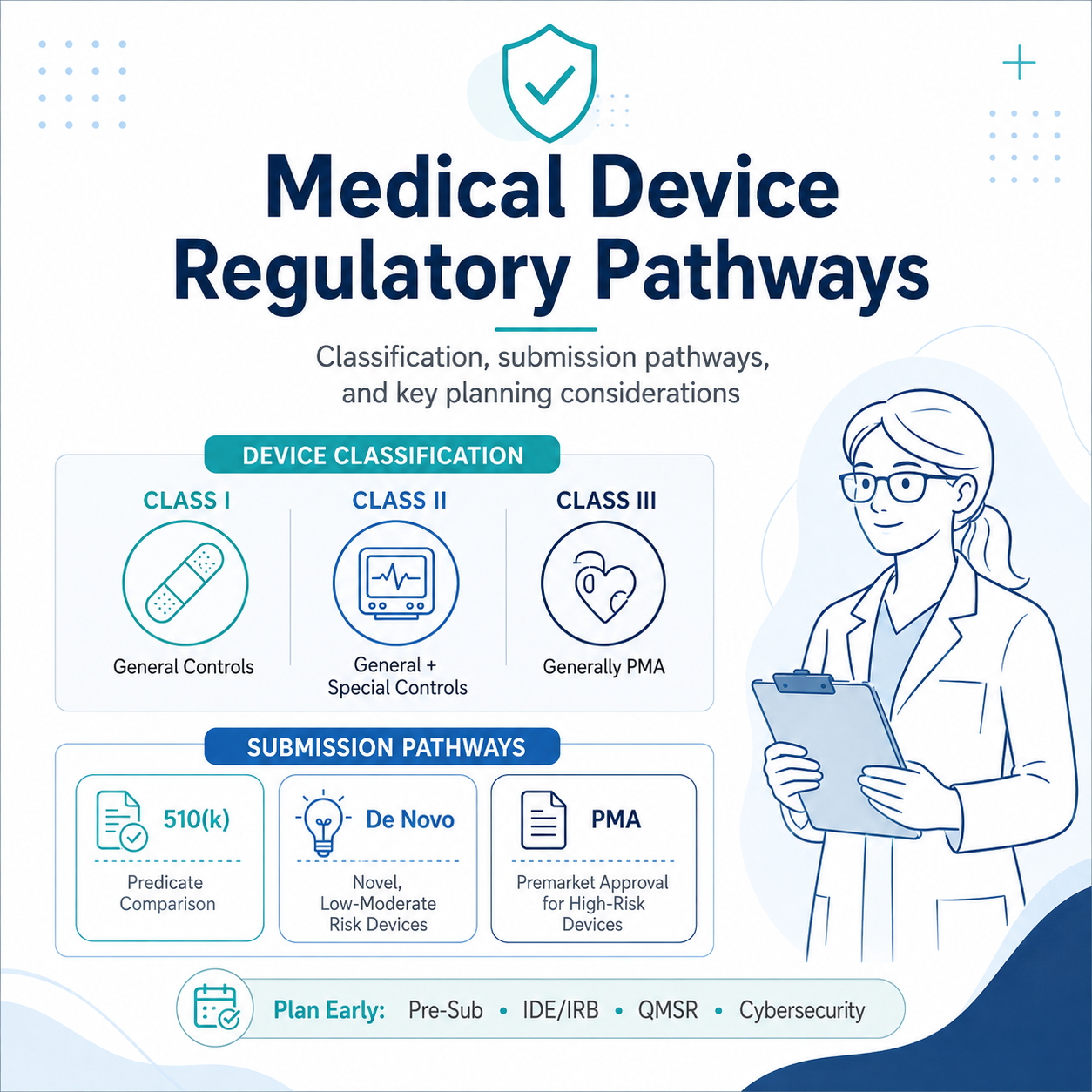
The FDA places medical devices into one of three regulatory classes: Class I, Class II, or Class III.
The class reflects the risks associated with a device and the level of regulatory control needed to provide reasonable assurance of safety and effectiveness. In general, regulatory control increases from Class I to Class III.
However, classification is not based on risk alone. The FDA also looks closely at what the device is intended to do. Some devices are primarily diagnostic, meaning they help detect, identify, measure, or provide information about a disease or condition. Others are therapeutic, meaning they are intended to treat, manage, or mitigate a condition. Devices may also be surgical, monitoring, assistive, or serve more than one function.
Those labels do not determine the class by themselves. Instead, the device’s intended use, indications for use, risks, and the controls needed to manage those risks all help determine how the FDA classifies it and what regulatory requirements apply.
That is why two devices that may look similar can still be regulated differently if they are intended to be used in different ways.
Class I devices generally have the lowest level of regulatory oversight and are subject to the FDA’s general controls.
These are often relatively simple devices with well understood risks. Examples include certain elastic bandages, examination tools, manual surgical instruments, and other basic medical products.
Many Class I devices are exempt from 510(k) premarket notification, although that does not mean they are exempt from all FDA requirements. Requirements such as establishment registration, device listing, labeling, and applicable quality requirements may still apply.
Class II devices need additional oversight because general controls alone are not enough to address their risks.
The FDA therefore uses special controls in addition to general controls. Depending on the device type, those controls can include performance testing, labeling requirements, postmarket surveillance, patient registries, or other device-specific measures.
Examples include many syringes, endoscopes, powered wheelchairs, diagnostic systems, and other medical technologies that require additional evidence or controls.
Most Class II devices require a 510(k) Premarket Notification, although some Class II device types are exempt.
Class III devices receive the highest level of regulatory oversight.
These can include devices that support or sustain human life, are important in preventing impairment of human health, or present a potential unreasonable risk of illness or injury. Examples include certain implantable heart devices, heart valves, breast implants, and other high-risk technologies.
Devices subject to Class III premarket approval requirements generally require a Premarket Approval application, or PMA. There are historical exceptions, so Class III does not automatically mean PMA in every situation.
It can be tempting to think of the classes as:
Class I = simple
Class II = more complicated
Class III = very complicated
However, that is not really how FDA classification works.
A device’s classification can change depending on what it is intended to do. Even a familiar device can be regulated differently if its intended use or indications change.
That is why identifying the right classification, product code, and intended use early is such an important part of regulatory planning. FDA maintains classification regulations and a Product Classification Database to help developers understand how similar devices are regulated.
If the classification or applicable regulatory requirements remain unclear, the FDA also offers a 513(g) Requests for Information, which allows a company to request the FDA’s views on the classification and regulatory requirements that may apply to a particular device.
For many non-exempt Class II devices, the next step is the 510(k) Premarket Notification pathway.
The basic idea behind a 510(k) is substantial equivalence. Rather than evaluating the device in isolation, the FDA compares it with an appropriate legally marketed device, known as a predicate device. The goal is to show that the new device has the same intended use and that any technological differences do not raise different questions of safety or effectiveness.
That does not mean the two devices have to be identical. Newer devices often use different materials, software, components, or design features. What matters is whether those differences are adequately supported by evidence and whether the new device can still be shown to be as safe and effective as the predicate.
The amount and type of evidence required depends on the device. A 510(k) may include bench testing, software documentation, electrical safety and EMC testing, biocompatibility, usability testing, and, when needed, clinical data.
If the FDA agrees that the device is substantially equivalent, the device receives FDA clearance. That is different from FDA approval, which is the term used for devices reviewed through the Premarket Approval, or PMA, pathway. In a PMA, FDA reviews scientific evidence to determine whether there is reasonable assurance that the device is safe and effective for its intended use.
The De Novo pathway is designed for novel medical devices that do not have an appropriate legally marketed predicate, but whose risks can still be managed through general controls alone or through general and special controls.
In other words, a device may be new enough that a traditional 510(k) comparison does not make sense, without necessarily belonging in Class III. In that situation, a De Novo request gives the FDA a way to evaluate the device and, if appropriate, establish a new Class I or Class II classification.
A company can submit a De Novo request directly when there is no suitable predicate. It does not first need to submit a 510(k) and receive a “Not Substantially Equivalent” decision.
One of the important outcomes of a successful De Novo request is that it creates a new device classification. That classification can then help define the regulatory path for similar devices in the future, and the De Novo device may potentially serve as a predicate for later 510(k) submissions when appropriate.
For devices subject to Class III premarket approval requirements, the regulatory path is more demanding.
Unlike a 510(k), which is built around comparison to a legally marketed predicate, a PMA requires the manufacturer to provide scientific evidence showing there is reasonable assurance that the device is safe and effective for its intended use.
Because PMA is generally used for higher-risk Class III devices, the supporting evidence can be extensive. Depending on the device, that may include engineering and performance testing, nonclinical studies, manufacturing information, and clinical evidence.
A successful PMA results in FDA approval. That is different from the FDA clearance issued through the 510(k) pathway. The distinction reflects the fact that the two pathways ask different regulatory questions: a 510(k) focuses on substantial equivalence, while a PMA focuses on whether the submitted evidence supports the device’s safety and effectiveness.
Some device programs bring additional regulatory considerations that do not fit neatly into the standard 510(k), De Novo, or PMA discussion. Two important examples are devices for rare diseases or conditions and devices intended for pediatric patients.
Some medical devices are developed for patient populations so small that the usual development path may not be practical. FDA’s humanitarian-device framework is intended for certain devices that address rare diseases or conditions.
A Humanitarian Use Device, or HUD, is a device intended to benefit patients with a disease or condition that affects or is manifested in no more than 8,000 people in the United States each year.
The terms HUD and HDE are related, but they refer to different things. HUD is the designation for the device, while an HDE, or Humanitarian Device Exemption, is the marketing application used to seek authorization to market that HUD. In practice, that means a company first seeks HUD designation and then submits an HDE application.
The HDE pathway also uses a different evidentiary standard from PMA. Rather than requiring the same demonstration of effectiveness expected in a PMA, FDA considers whether the device’s probable benefit to health outweighs the risk of injury or illness, along with the other applicable requirements for the pathway.
Pediatric medical devices often require a different level of planning because children are not simply smaller versions of adult patients.
Differences in anatomy, growth and development, device sizing, disease progression, and the availability of clinical data can all affect how a pediatric device is designed, tested, and evaluated.
That does not mean pediatric devices follow their own separate FDA marketing pathway. Instead, FDA reviews them through the existing device pathways, with the regulatory and clinical strategy tailored to the specific device, intended use, and patient population.
In practice, that means pediatric considerations become part of the broader design, testing, clinical, and regulatory strategy from the beginning rather than something added later in development.
Once you have a sense of which regulatory pathway may fit your device, it helps to start looking ahead. The submission itself may still be a long way off, but some of the decisions you make during development can determine how smoothly you get there.
One of the most useful things a medical device company can do is talk with the FDA early. Through the Q-Submission Program, companies can request a Pre-Submission, or Pre-Sub, to ask specific questions and get FDA feedback before making a formal submission. This can be especially helpful when you are working through questions about a predicate, proposed indications, testing plans, or whether your clinical strategy will support the submission you ultimately want to make.
A Pre-Sub is not a guarantee that the FDA will later clear or approve the device. What it does give you is an opportunity to check important assumptions while there is still time to adjust the plan.
That becomes especially important if human studies may be needed. Before a study can begin, there may be Internal Review Board (IRB) and Investigational Device Exemption (IDE) requirements to work through. Significant-risk device studies generally require both an FDA-approved IDE and IRB approval, while nonsignificant-risk studies usually proceed under IRB oversight and the FDA’s abbreviated IDE requirements. If an investigational drug or biologic is also involved, an Investigational New Drug (IND) approval may come into the picture as well.
Those steps take time, and they can affect more than the study start date. The protocol, endpoints, sites, budget, and type of evidence being collected can all tie back to the regulatory strategy, which is another reason to think through these questions early.
At the same time, the device should be developing within an appropriate quality system. FDA’s Quality Management System Regulation (QMSR) became effective on February 2, 2026 and incorporates ISO 13485:2016 by reference, along with additional FDA requirements. In practical terms, quality is not something to create when the submission is almost ready. Design records, risk management, manufacturing controls, and other documentation should build as the device builds.
The same goes for cybersecurity when software, firmware, programmable components, or connectivity are involved. Cybersecurity decisions can affect the device’s architecture, testing, risk analysis, labeling, and eventually the premarket submission. It is much easier to address those questions while the design is still evolving than after it has been locked.
All of these pieces ultimately support the same goal: making sure the way the device is designed, tested, studied, and documented lines up with the regulatory path you plan to follow.
If there is one theme running through all of these pathways, it is that the earlier you understand the regulatory landscape around your device, the better.
Classification, intended use, predicate strategy, testing, clinical evidence, quality, and cybersecurity are not separate boxes that get checked one after another. The decisions made in one area often affect the others, and together they shape how the device moves from development toward the market.
And that planning does not stop once a device is cleared or approved. Manufacturers may continue to have responsibilities for registration and listing, labeling, complaint handling, Medical Device Reporting (MDR), postmarket surveillance when applicable, and corrections or recalls. These requirements vary by device, but they are worth understanding before launch rather than discovering afterward.
Medical device regulation can get complicated quickly, and there is no reason to try to memorize every requirement at once. A better approach is to know which questions need to be answered next, use the FDA’s guidance documents to dig deeper, and bring important questions to the Agency when the path is not clear.